First Audiobook Ever Made? The 1930s Talking Books Story
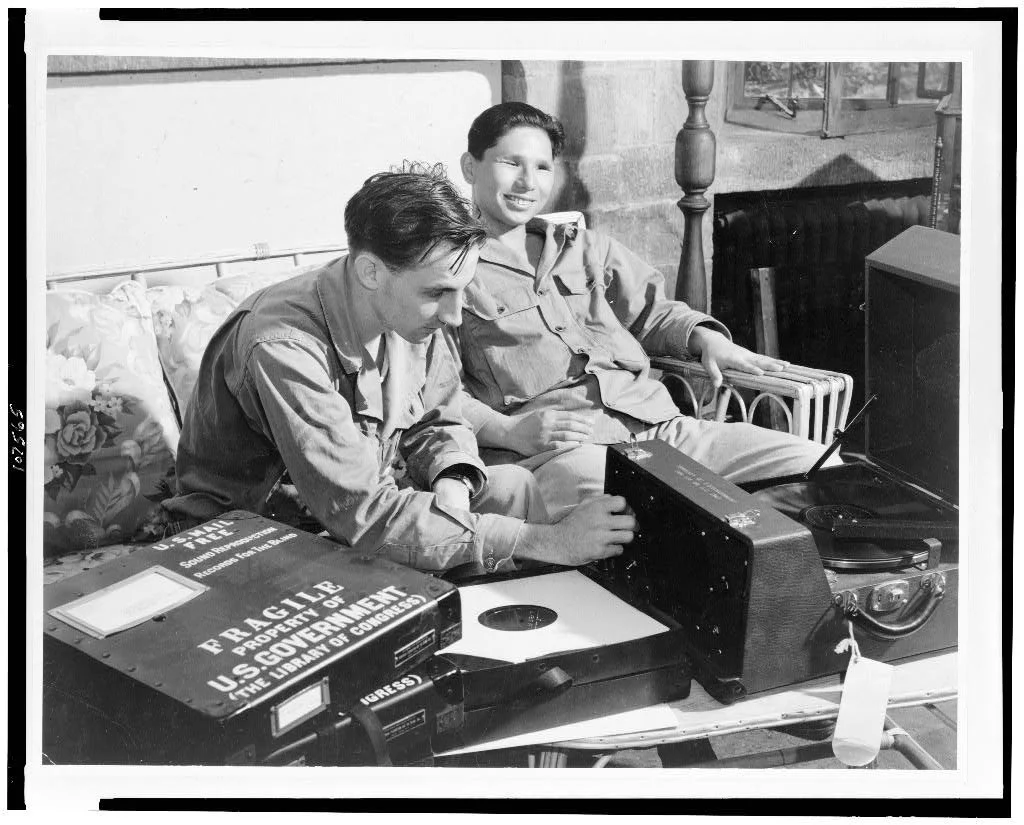
Blinded airmen listen to a Library of Congress Talking Book record, WWII era. Photo: Library of Congress Prints & Photographs Division, LC-USZ62-107565.
Picture this: it's 1934, and records still spin at 78 rpm and hold a few minutes of music per side. Meanwhile, in a New York studio, someone is reading Shakespeare into a microphone for slow-spinning discs that will carry a whole book. Ask what the first audiobook ever made was, and the honest answer starts here, with talking books for the blind.
Blind readers had long-playing records fourteen years before the commercial LP arrived in 1948. They just called them Talking Books. And if you work in audiobooks today, a surprising amount of what you do was worked out on those discs.
The History of Audiobooks Starts With Edison (Sort Of)
The idea is nearly as old as recorded sound. When Thomas Edison listed ten possible uses for his new phonograph in the North American Review in 1878, number two was "phonographic books, which will speak to blind people without effort on their part." Reproduction of music came in at number four.
The technology took another half century to catch up. Then the policy side moved quickly. The Pratt-Smoot Act became law on March 3, 1931, creating a national program, run by the Library of Congress, to supply books to blind adults. At first those books were braille only. In March 1933 an amendment, signed by President Hoover on his last day in office, allowed the money to be spent on recorded books too. Braille publishers fought it hard, and to get it through, senators agreed to hold first-year spending on recordings to $10,000.
The Tech: A Basement Inventor and a Very Long Record
The American Foundation for the Blind (AFB) first tried to get the big record companies, Edison's company and then RCA, to manufacture recorded books. None of them could make tiny, unprofitable runs pay, so the AFB built the thing itself.
Its secret weapon was Jackson Oscar "J.O." Kleber, an electrical engineer from the recording labs at RCA and a Bell Telephone Laboratories subsidiary, who came to the AFB after a Depression layoff. Colleagues described him as a classic basement inventor. He produced a 12-inch, 33 1/3 rpm disc made of a synthetic called Vinylite, flexible enough to survive the mail and durable enough to circulate through libraries. According to the Library of Congress, the discs were cut at 150 grooves to the inch and gave about thirty minutes of reading per record, so a 60,000-word book fit on eight or nine double-sided discs.
Most blind readers couldn't afford a player, though. So the AFB went to President Franklin D. Roosevelt, with Helen Keller along for the meeting. On September 19, 1935, Roosevelt transferred $211,500 to the Library of Congress to build 5,000 Talking Book machines as a Works Progress Administration (WPA) project. By the time it ended in 1942, the WPA shop had built 23,000 machines. At one point, 89 of its 197 workers were themselves visually impaired.
The First Catalog (and a Very Familiar Argument)
The Library of Congress leaned toward books of "an informing nature," meaning classics. The AFB's executive director, Robert Irwin, knew from blind readers' letters that a classics-only list could kill the program. He argued the first titles should "include books which the rank and file of seeing people would rush to the library to borrow."
They compromised. The Library's first 1934 order paired the Psalms, the Declaration of Independence, the Constitution and Shakespeare's As You Like It, The Merchant of Venice and Hamlet with popular fiction: Kipling's The Brushwood Boy, E.M. Delafield's The Diary of a Provincial Lady and P.G. Wodehouse's Very Good, Jeeves. A Library official even sent instructions to always list the "serious" titles first.
Prestige or popularity? Publishers still have this argument every time they plan an audio list.
The Rules They Wrote Still Sound Familiar
Rights. Publishers worried that recordings would compete with print. After a year of negotiations, the AFB agreed to pay a token $25 per book. Every record would be labeled "solely for the use of the blind," and the recordings would never be sold to sighted people, played at public meetings or broadcast.
Pace. Kleber's open questions included what reading speed was best and what vocal qualities made a good narrator. The program settled on a standard speed of 160 to 180 words per minute, against roughly 60 for a typical braille reader. That range still sounds about right for a comfortable audiobook read.
Production. Masters were recorded in the AFB's studio, then plated and pressed, first at RCA Victor's plant in Camden, New Jersey, and later in-house, in runs of 100 copies per title. Indie producers will recognize the small-run problem.
The program also built careers. Mitzi Friedlander began narrating Talking Books at the American Printing House for the Blind in 1962. In 1997 she was honored as the first person in the program's history to record 1,000 books, and she had recorded more than 2,200 titles by the time she retired in 2015.
Meanwhile, in London: Talking Books at the RNIB
Britain got there on its own path. Captain Ian Fraser was blinded at the Battle of the Somme in 1916, and he found braille slow going. According to the RNIB, he once cried out, "If books could only talk!" RNIB set up its own London recording studio in 1934. By narrowing the grooves on shellac records and slowing them down, it got 25 minutes per side, and an average novel took about 10 discs. The first RNIB Talking Books went out to readers on November 7, 1935.
FAQ
When were audiobooks invented?
It depends on where you draw the line. In the US, the AFB made test recordings in 1932, including a chapter of Helen Keller's Midstream and Poe's "The Raven." The Library of Congress talking books program began ordering full books in 1934. By January 1935 it had 35 titles. In the UK, the RNIB's Talking Book Library launched in 1935. (The word "audiobook" came much later. The Audio Publishers Association adopted it as the industry standard in 1994.)
What was the first audiobook ever made?
This is where it gets fun. Guinness World Records names Joseph Conrad's Typhoon, recorded by the RNIB in 1935, as the first audiobook. Guinness notes that the AFB had already recorded short stories, extracts and poems in 1932 and calls Typhoon the first novel, "technically a novella." A copy of the four-disc set turned up with a record collector in Canada in 2016.
The British side has a mystery of its own. Audiobook historian Matthew Rubery, who helped track down that Typhoon set, writes that it's "widely believed" Agatha Christie's The Murder of Roger Ackroyd was Britain's first talking book. He says he has never been able to confirm whether Conrad or Christie came first, but he calls Conrad "the frontrunner," partly because Conrad's narrator, Anthony McDonald, is said to have read the very first one. No copies of the 1935 Christie recording are known to survive.
Here's the wrinkle. The US program was already recording full books, including novels like The Diary of a Provincial Lady, in 1934, a year before the RNIB's first releases. So Typhoon may be the oldest surviving British talking book, but "the first audiobook ever made" probably belongs to one of those American discs. Exactly which one, nobody can say for sure.
What is the Library of Congress Talking Books program?
It's the free library service that began with the 1931 Pratt-Smoot Act. Today it's called the National Library Service for the Blind and Print Disabled (NLS). Since 1966 it has served anyone who can't read standard print because of a visual or physical disability. It moved from discs to cassettes to digital, and it now delivers books through its BARD app, which launched on iOS in 2013 and Android in 2015.
From Vinylite to Your Phone
The commercial industry took the same road. The Audio Publishers Association reports that U.S. audiobook sales reached $2.43 billion in 2025, up 9%, with more than 750,000 active titles. Most listeners have never heard of J.O. Kleber or Ian Fraser, but they're using what those programs built: long-playing formats, a comfortable reading pace, rights carved out for audio, and a catalog balancing the classics against what people actually want to hear.
Before the apps and subscriptions, the audiobook was an accessibility tool. Someone had to work out how fast to read, which voice to cast, which books to record first and how to make the economics work. Here at Sounds and Such, those are still the questions behind every project, from casting the right narrator to final mastering and distribution. It's nice to know people were working through them in studios in New York and London more than ninety years ago.
Sources
Library of Congress, NLS History: https://www.loc.gov/nls/who-we-are/history/
Frances A. Koestler, The Unseen Minority, Ch. 10 (AFB): https://afb.org/about-afb/history/online-library/unseen-minority/chapter-10
AFB, "The Making of a Talking Book": https://www.afb.org/about-afb/history/online-museums/afb-talking-book-exhibit/early-history-why/making-talking-book
Library of Congress, History of the Edison cylinder phonograph: https://www.loc.gov/collections/edison-company-motion-pictures-and-sound-recordings/articles-and-essays/history-of-edison-sound-recordings/history-of-the-cylinder-phonograph/
Guinness World Records, "First audiobook": https://www.guinnessworldrecords.com/world-records/453779-first-audiobook
RNIB, "Celebrating the history of Talking Books": https://www.rnib.org.uk/living-with-sight-loss/independent-living/leisure/reading-and-books/history-of-talking-books/
Matthew Rubery, "Britain's First Talking Book," Audiobook History (2016): https://audiobookhistory.wordpress.com/2016/11/24/britains-first-talking-book/
Audio Publishers Association, "A History of Audiobooks": https://www.audiopub.org/history-of-audiobooks ; sales survey (June 5, 2026): https://www.audiopub.org/surveys
Courier-Journal, Feb. 4, 2015 (Mitzi Friedlander)